


Europe | UK | Poultry | Animal Health | Corporate | Investment
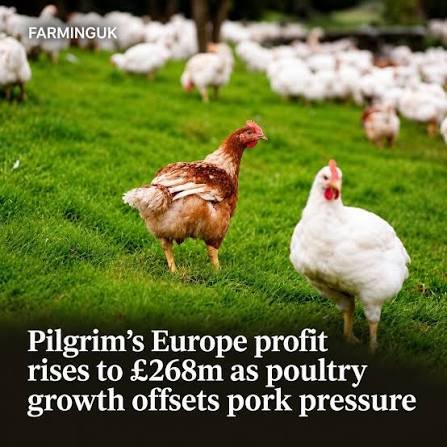
Pilgrim’s Europe has reported stronger financial performance for FY2025, with revenue rising to approximately £4.12 billion from £4.07 billion, while operating profit increased to £267.7 million from £242.4 million. Operating profit margin before restructuring costs improved from 6.0% to 6.5%.
The improvement is notable because revenue increased by only about 1.2%, while operating profit grew by approximately 10.4%. This indicates that operational efficiency, product mix, poultry growth and commercial execution contributed disproportionately to earnings improvement.
The company also invested £108.6 million during FY2025 across manufacturing, farming and supply-chain capabilities. The investment is strategically important because Pilgrim’s Europe is an integrated protein business spanning poultry, pork, prepared foods, agriculture and logistics rather than a standalone meat processor.
For the animal-health industry, the significance extends beyond financial performance. Investment in modern poultry infrastructure increasingly overlaps with biosecurity, environmental control, welfare, disease surveillance, flock productivity and traceability. The economics of large integrated producers therefore create a growing market for technologies that can demonstrate measurable improvements in biological and operational outcomes.
Financial Performance: Profit Growing Faster Than Revenue
Pilgrim’s Europe generated approximately £4.12 billion in revenue in FY2025, compared with £4.07 billion in FY2024.
Operating profit increased from £242.4 million to £267.7 million, an increase of approximately £25.3 million or 10.4%.
Metric |
FY2024 |
FY2025 |
Change |
|---|---|---|---|
Revenue |
£4.07bn |
£4.12bn |
+1.2% |
Operating profit |
£242.4m |
£267.7m |
+10.4% |
Operating margin* |
6.0% |
6.5% |
+50 bps |
Capital investment |
— |
£108.6m |
— |
Employees |
— |
~17,000 |
— |
Operating sites |
40+ |
40+ |
Integrated network |
*Before restructuring costs.
The contrast between revenue and operating-profit growth is particularly important. A roughly 1.2% increase in sales generated a 10.4% increase in operating profit, suggesting that the business is extracting greater value from its existing commercial and operational platform rather than relying solely on volume expansion.
Pilgrim’s Europe attributed the performance to poultry growth, operational improvements, customer contract wins, disciplined cost management and commercial execution. The company also reported stronger performance from its value-added portfolio.
The £108.6 million investment represents approximately 2.6% of FY2025 revenue, demonstrating that capital deployment remains material relative to the size of the business.
Poultry Is Becoming an Increasingly Important Growth Engine
Poultry was a key contributor to the FY2025 improvement.
Pilgrim’s Europe reported that poultry growth was supported by operational improvements, new customer contracts, cost discipline and stronger commercial execution. The business also strengthened its relationships with retail and foodservice customers. The underlying UK market provides an important backdrop.
According to UK government agricultural statistics, home-fed poultry meat production reached approximately 2.0 million tonnes in 2025, up 0.3% year-on-year. Table-chicken production reached approximately 1.86 million tonnes, while the UK poultry population increased 4.1% to approximately 183 million birds. Broilers accounted for around 121 million birds, or 66% of total poultry.
The market is therefore large enough that relatively small improvements in flock performance, mortality, feed efficiency, processing yield or disease control can translate into substantial financial value for an integrated producer.
The latest monthly data also show continued scale: in August 2026, UK broiler slaughterings were approximately 92.9 million birds, while total poultry meat production reached 172.1 thousand tonnes, up 3.3% from August 2025.
£108.6 Million of Capex: More Than Factory Expansion
The most strategically important element of the announcement may be the £108.6 million investment across manufacturing, farming and supply chain. This is not simply investment in processing capacity.
Pilgrim’s Europe operates an integrated system in which poultry farms, livestock supply, processing plants, further-processing facilities, packaging, cold-chain infrastructure and distribution need to remain synchronised. Investment in one part of the chain has limited value if another part becomes the bottleneck.
For example: More birds → more farm capacity → greater transport requirement → greater slaughter capacity → greater processing capacity → more cold storage → greater distribution capability
That creates a broad investment opportunity for suppliers of:
-
poultry housing and environmental-control systems;
-
ventilation and climate-management technology;
-
automated feeding and watering;
-
precision weighing and flock monitoring;
-
disease surveillance;
-
diagnostics;
-
biosecurity systems;
-
vaccination-support technologies;
-
feed additives and gut-health solutions;
-
litter-management technologies;
-
welfare monitoring;
-
digital traceability;
-
automation and robotics.
The commercial opportunity is particularly attractive where suppliers can demonstrate a direct connection between technology deployment and mortality, feed conversion, condemnations, welfare scores, growth rate, uniformity or processing yield.
Animal Health Becomes Part of the Capital-Allocation Equation
The relationship between infrastructure investment and animal health is increasingly direct. Modern poultry facilities can improve the producer’s ability to control variables such as:
temperature → humidity → ventilation → ammonia → litter quality → bird behaviour → respiratory health → locomotion → growth → mortality → processing quality.
The UK government’s current avian-influenza guidance illustrates the importance of this relationship. Biosecurity requirements include maintaining poultry housing, separating bird groups, controlling standing water, cleaning and disinfecting housing, controlling rodents and pests, restricting access and maintaining records of bird movements and mortality.
More importantly, the government introduced a Poultry Biosecurity Review scheme in June 2026, providing funding for veterinary-led reviews intended to reduce disease incidence—including avian influenza—and improve animal health, welfare and productivity.
The latest UK surveillance environment reinforces the point. On 3 October 2026, the government reported the first HPAI H5N5 outbreak of the 2026–27 season and assessed the HPAI H5 risk in wild birds as medium, while the poultry exposure risk was assessed as low where biosecurity is suboptimal or poor and very low where stringent biosecurity is consistently applied.
For large integrated poultry businesses, biosecurity is therefore not merely a veterinary issue. It is an asset-protection and earnings-protection issue.
Higher Welfare Is Increasingly Rewriting Farm Economics
Pilgrim’s Europe also demonstrated how retailer commitments can reshape production infrastructure.
During FY2025, the company became the exclusive supplier of all Waitrose own-label chicken produced to Better Chicken Commitment requirements, reportedly completing the transition 18 months ahead of the wider industry timeline. The Better Chicken Commitment requires, among other measures, a maximum stocking density of 30 kg/m² or less and the use of breeds demonstrating improved welfare outcomes.
These requirements have biological and financial consequences. Lower stocking densities and slower-growing, higher-welfare genetics can require changes in:
-
housing capacity;
-
flock planning;
-
genetics;
-
ventilation;
-
litter management;
-
lighting;
-
farm throughput;
-
processing schedules;
-
working capital;
-
customer pricing.
The UK government’s 2025 livestock statistics specifically note that the broiler sector continued its transition towards lower stocking densities in response to retailer-led animal-welfare commitments.
This is an important structural trend: animal welfare is moving from a CSR category into a production-design variable.
Poultry Health and Precision Farming Are Converging
The next phase of poultry investment is likely to increasingly connect animal health with data. A modern integrated poultry system can combine:
Sensors → environmental data → bird behaviour → feed/water consumption → weight → mortality → veterinary observations → laboratory diagnostics → intervention → processing outcomes.
The resulting data architecture can allow producers to identify deviations before they become large biological or financial events.
For example, an unusual change in water consumption combined with altered temperature, ventilation and mortality patterns may provide an earlier warning of flock-level stress or disease than conventional periodic inspection alone. For animal-health technology companies, this creates a new competitive category between veterinary medicine, diagnostics and precision livestock farming.
Broader Integrated-Protein Strategy
Pilgrim’s Europe is not pursuing poultry investment in isolation. The company also secured a 10-year supply agreement with Waitrose supporting the retailer’s transition to 100% British free-range own-label pork by 2027.
In addition, Pilgrim’s Europe acquired Hermitage AI’s Lincolnshire and Cambridgeshire operations, transferring responsibility for two Genetic Transfer Centres. The company said integrating genetics would create opportunities for improvements in production efficiency, meat quality, animal health and resilience.
The company is effectively moving further upstream: Genetics → breeding → farming → processing → prepared foods → retail customer
Greater vertical integration potentially gives the business greater control over genetics, production consistency, health and supply security. It also creates a much larger addressable market for technologies that can improve biological performance across multiple stages of the chain.
Innovation and Product Complexity Are Also Rising
Pilgrim’s Europe launched more than 800 products during 2025 across retail, foodservice and branded categories. That is commercially positive but operationally complex. Every additional SKU can create requirements for:
-
formulation;
-
packaging;
-
allergen management;
-
line changeovers;
-
quality control;
-
traceability;
-
cold-chain management;
-
production scheduling.
Consequently, the return on manufacturing investment increasingly depends on flexibility and automation, not simply additional physical capacity. This is another potential opportunity for technology companies selling robotics, machine vision, digital production management, predictive maintenance and quality-control systems.
Industry Takeaway
Pilgrim’s Europe’s FY2025 results are more significant than a simple profit-growth story.
Revenue increased only modestly, but operating profit grew more than 10%, while the company invested £108.6 million across farming, manufacturing and supply-chain infrastructure. At the same time, poultry growth, higher-welfare customer commitments, vertical integration and supply-chain resilience are becoming increasingly interconnected.
For the animal-health industry, the implication is clear: The next generation of poultry customers will increasingly buy outcomes, not products.
Vaccines, diagnostics, feed additives, biosecurity systems, environmental monitoring, welfare technologies and precision-farming platforms will compete on their ability to produce measurable improvements in bird health + welfare + productivity + economics.
That creates a favourable environment for suppliers that can combine science, data, field evidence and measurable farm-level ROI.
Animal-Health Industry Signal: POSITIVE
Primary opportunity areas:
Biosecurity | Diagnostics | Precision Livestock Farming | Gut Health | Vaccination | Welfare Monitoring | Environmental Control | Genetics | Digital Traceability
Risk factors:
Commodity-price volatility | Consumer spending pressure | Agricultural input costs | HPAI and other disease shocks | Regulatory/welfare requirements | Capital intensity
Overall assessment:
Pilgrim’s Europe’s FY2025 performance strengthens the case for continued investment in integrated poultry production and creates a larger addressable opportunity for animal-health and precision-farming technologies capable of demonstrating measurable biological and economic returns.
Key Sources:
-
Pilgrim’s Europe FY2025 performance and investment disclosures.
-
UK Government, Agriculture in the United Kingdom 2025 — Livestock.
-
UK Government, Livestock Populations in the UK at 1 June 2025.
-
UK Government, latest poultry slaughter and production statistics, August 2026.
-
UK Government/DEFRA/APHA, avian-influenza biosecurity guidance and 2026 risk assessment.
-
Better Chicken Commitment, EU/UK welfare standards.
-
Pilgrim’s Europe–Waitrose 10-year British pork partnership.
-
Pilgrim’s Europe acquisition of Hermitage AI genetics operations.

