


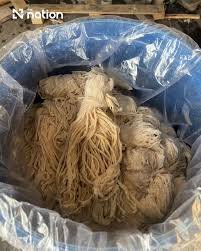
Thailand’s Department of Livestock Development (DLD), working alongside consumer protection police, has seized approximately 24.64 tonnes of salted pig casings from a cold-storage facility in Samut Sakhon province after officials were unable to establish the products’ origin and legal movement documentation.
The seizure highlights Thailand’s continuing efforts to strengthen traceability and enforcement across the animal-product supply chain. The products were stored in 154 plastic drums, each reportedly containing approximately 160 kg of salted pig casings. The total consignment was valued at more than THB 5 million.
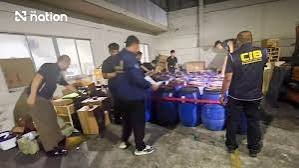
Joint enforcement operation uncovers undocumented animal products
The operation was conducted at a cold-storage facility in Ban Ko subdistrict, Mueang Samut Sakhon district, following a public tip-off. The inspection was carried out under a provincial court warrant. Participating agencies included:
-
Department of Livestock Development special operations personnel.
-
Food and Animal Drug Control Division.
-
Chonburi Animal Quarantine Station.
-
Samut Sakhon Provincial Livestock Office.
-
Consumer Protection Police Bureau.
Authorities reportedly found the salted pig casings without adequate documentation establishing their origin and transportation history.
The individual responsible for the facility stated that the goods were being stored for a nearby company involved in casing production.
However, officials had not established the source of the consignment at the time of reporting. Samples were collected for laboratory testing to determine whether the products contained pathogens. The stock was placed under seizure at the facility for seven working days.
The claimant was given the opportunity to submit documents proving the origin and legality of the products, including valid movement permits. Failure to provide satisfactory documentation could result in prosecution under Thailand’s Animal Disease Act B.E. 2558 (2015) and other applicable legislation.
Authorities have also indicated that they will pursue the importers if the products are found to have entered the country unlawfully.
Why pig-casing traceability matters to animal health
Animal-derived products can create biosecurity concerns when their origin, processing and transportation history cannot be established. Pig casings are particularly relevant because they can move through complex international supply chains involving slaughterhouses, processors, storage facilities and food manufacturers.
The absence of documentation does not prove that a consignment is infected or illegally imported. However, without traceability, veterinary authorities may find it difficult to establish:
-
The original animal population.
-
The country and premises of origin.
-
The disease-health status of the source animals.
-
Whether appropriate veterinary certification was issued.
-
Whether the product underwent required processing.
-
Whether the consignment passed through approved border controls.

